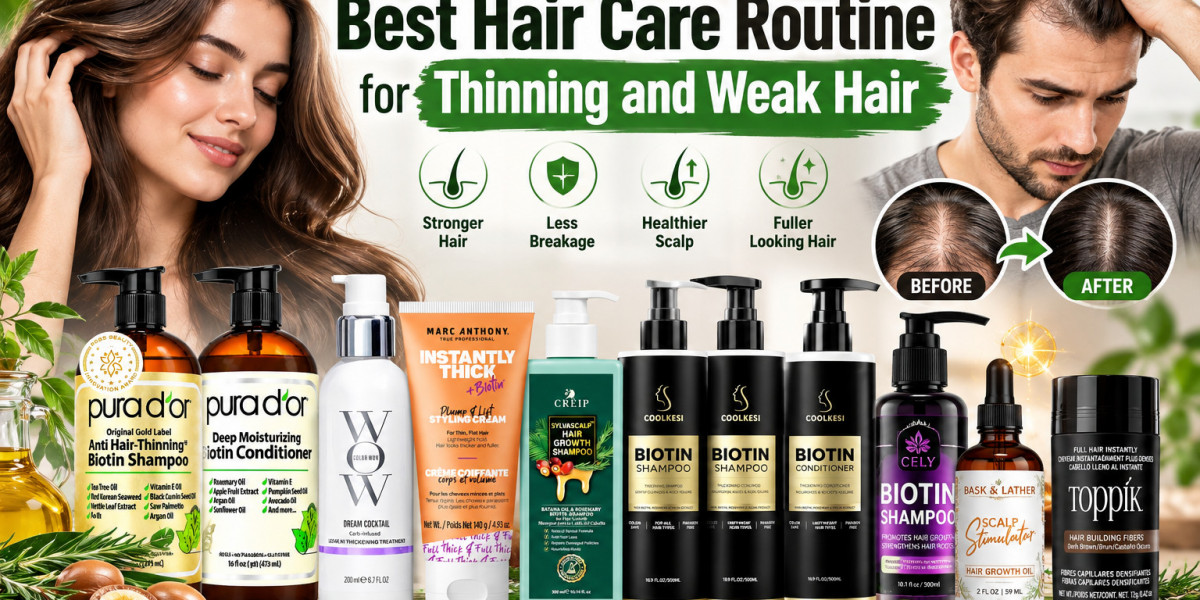

Thinning and weak hair can be frustrating, especially when your hair starts looking less dense, breaks easily, or feels noticeably finer than it used to. While some hair changes are temporary, ongoing thinning can sometimes be related to genetics, hormones, nutritional issues, scalp conditions, stress, or damage caused by everyday hair-care habits.
The good news is that a consistent hair-care routine can help protect fragile strands, reduce unnecessary breakage, maintain a healthy scalp, and make your hair look fuller and healthier. Choosing the right shampoo, conditioner, scalp-care products, and hair-growth treatments is also important.
This guide explains practical hair care for thinning hair, including how to distinguish hair thinning from breakage, which products may be worth considering, and which habits can help protect weak hair.
Why Does Hair Become Thin or Weak?
Hair can become thinner or weaker for many different reasons. Understanding the possible cause is important because a routine that works for hair breakage may not address progressive hair loss.
Common factors include:
l Genetics and hereditary hair loss
l Aging
l Hormonal changes
l Physical or emotional stress
l Poor nutrition or certain nutrient deficiencies
l Some medical conditions
l Certain medications
l Scalp inflammation or skin conditions
l Excessive heat styling
l Frequent chemical treatments
l Tight hairstyles that repeatedly pull on the hair
l Rough brushing or aggressive towel drying
Another important distinction is that hair may appear thinner because individual strands are becoming finer, because fewer hairs are growing in certain areas, or because the existing hair is breaking before it reaches its normal length.
If you suddenly notice significant shedding, bald patches, scalp pain, itching, scaling, or rapid changes in hair density, it is worth discussing the symptoms with a qualified healthcare professional.
Hair Thinning vs Hair Breakage
Hair thinning and hair breakage can look similar, but they are not exactly the same.
Hair thinning generally refers to reduced hair density or progressively finer hair. You may notice a widening part, a smaller ponytail, more visible scalp, or reduced density around the temples or crown.
Hair breakage, on the other hand, happens when the hair shaft snaps. Short broken hairs around the hairline, uneven lengths, split ends, and increased frizz can be signs of breakage.
You can also experience both at the same time.
For example, someone experiencing hereditary hair thinning may also have fragile hair because of frequent heat styling. In this situation, treating the underlying cause of thinning while improving hair-care habits can be more useful than relying on a single product.
How to Build a Routine for Thinning Hair
A good routine for thinning hair does not need to contain dozens of products. The goal should be to keep the scalp clean, minimize damage, condition the lengths, and use evidence-based treatments when appropriate.
A simple routine can include the following steps:
1. Cleanse the scalp regularly
Choose a shampoo based on your scalp type rather than simply choosing a product marketed as a “hair growth shampoo.”
If your scalp becomes oily quickly, you may need more frequent washing. If your scalp is dry or sensitive, a gentler shampoo may be preferable.
Use your fingertips to massage shampoo into the scalp without aggressively scratching. The purpose is to remove excess oil, sweat, styling products, and buildup while avoiding unnecessary irritation.
2. Condition the lengths
Apply conditioner mainly to the mid-lengths and ends. Conditioner can improve softness and manageability, helping reduce friction during brushing and styling.
People with fine hair may prefer a lightweight conditioner, while dry or damaged hair may benefit from a richer formula.
3. Handle wet hair gently
Wet hair can be more vulnerable to stretching and breakage. Instead of aggressively rubbing your hair with a towel, gently squeeze out excess water and use a soft towel or T-shirt.
Use a wide-tooth comb when detangling, starting from the ends and gradually moving upward.
4. Protect your hair from heat
Frequent use of flat irons, curling irons, and high-temperature blow dryers can weaken the hair shaft.
If you use heat styling tools, keep the temperature as low as practical and consider using a heat-protective product.
Choosing the Right Shampoo and Conditioner
When shopping for thinning hair products, it is easy to become distracted by labels promising thicker, fuller, or faster-growing hair.
A better approach is to look at what the product is actually designed to do.
For shampoo, consider:
l Your scalp type
l How frequently you wash your hair
l Whether your scalp is oily or dry
l Whether you experience buildup
l Whether the formula causes irritation
For conditioner, focus on ingredients and formulas that improve softness, reduce friction, and make hair easier to manage.
Products containing moisturizing and conditioning ingredients can help improve the appearance and feel of fragile hair. However, a cosmetic shampoo or conditioner generally cannot address every underlying cause of hair loss.
A volumizing shampoo may temporarily make hair appear fuller, while a conditioning treatment may reduce the appearance of dryness and breakage. These benefits can be useful, but they should not be confused with treatment of the biological cause of hair loss.
Scalp Care for Thinning Hair
The scalp is the foundation from which hair grows, so scalp care should be part of a consistent routine.
Regular cleansing can help remove oil, sweat, dead skin cells, and styling-product buildup. Avoid scratching the scalp aggressively, particularly if it is irritated.
If you have persistent dandruff, redness, scaling, itching, or inflammation, choosing a specialized anti-dandruff or medicated shampoo may be appropriate. Persistent scalp symptoms should be evaluated by a healthcare professional rather than repeatedly trying different cosmetic products.
Scalp massage is also commonly included in hair-care routines. Gentle massage can feel relaxing and may help distribute scalp oils, but it should not be presented as a guaranteed treatment for hair loss.
For scalp care for thinning hair, the most important principles are gentle cleansing, avoiding unnecessary irritation, and addressing persistent scalp problems.
Hair Growth Products to Consider
There are many hair growth products, hair loss products, and hair regrowth products available today. However, their purposes and evidence can vary considerably.
If you are researching products for thinning hair, it is important to understand the difference between cosmetic products designed to improve the appearance of hair and treatments intended to address specific types of hair loss.
Minoxidil
Minoxidil is one of the better-known topical treatments for certain types of hair loss. It is available in different formulations and strengths depending on the market and product.
It may help some people maintain or improve hair growth when used consistently and appropriately. Results are not immediate, and continued use is generally necessary to maintain benefits.
Minoxidil is not suitable for every type of hair loss, and some people may experience scalp irritation or other side effects. Anyone considering it should follow the product instructions and discuss concerns with a healthcare professional, particularly when the cause of hair loss is unclear.
Hair Growth Serums
Hair growth serums are widely marketed for thinning and weak hair. Depending on the formulation, they may contain ingredients intended to condition the scalp, improve the appearance of hair, or support the scalp environment.
Some serums focus on cosmetic benefits such as hydration and improved hair texture, while others contain active ingredients promoted for hair growth.
Before buying a serum, check its ingredient list and claims carefully. A product marketed as a “growth serum” is not automatically equivalent to a clinically established hair-loss treatment.
If your primary concern is progressive thinning rather than breakage, consider identifying the cause before relying exclusively on cosmetic serums.
For additional information about products for thinning hair and other hair loss treatment options, see this helpful resource:
DHT-Related Products
Dihydrotestosterone, commonly called DHT, is involved in androgenetic or pattern hair loss. In genetically susceptible people, hair follicles can become progressively smaller over time.
This has led to many products being marketed as DHT blockers or DHT-control solutions.
However, not every DHT-related supplement, shampoo, serum, or topical product has the same level of evidence. Some products may primarily provide cosmetic scalp or hair benefits, while medically established treatments work through specific mechanisms and may require professional guidance.
If you suspect pattern hair loss, getting an appropriate diagnosis can help you understand which treatment options are relevant.
Hair Care Habits That Can Reduce Breakage
Even when you cannot completely prevent thinning caused by genetics or other internal factors, you can reduce avoidable damage.
Avoid very tight hairstyles
Repeated tension from tight ponytails, buns, braids, or extensions can contribute to hair damage and, in some cases, traction-related hair loss.
Choose looser hairstyles whenever possible and avoid repeatedly placing tension on the same area.
Reduce chemical processing
Frequent bleaching, relaxing, perming, or coloring can weaken the hair shaft.
If your hair is already fragile, spacing out chemical treatments and using appropriate conditioning products can help reduce additional damage.
Be gentle when brushing
Do not aggressively pull through tangles. Start at the ends and work upward gradually.
A suitable brush or wide-tooth comb can make detangling easier and reduce unnecessary tension.
Avoid excessive heat
Repeated high-temperature styling can contribute to dryness, split ends, and breakage. Allow your hair to air-dry when practical and use lower heat settings when using styling tools.
Protect your hair while sleeping
If your hair tangles easily, consider loosely tying it back or using a hairstyle that minimizes friction. Keeping hair comfortable and loosely secured can reduce mechanical stress overnight.
Mistakes People Make With Thinning Hair
One of the most common mistakes is assuming that every product labeled “hair growth” will regrow hair.
Another mistake is changing products too frequently. Hair-care and hair-growth routines often require consistency, and switching between products every few days makes it difficult to determine whether a particular approach is helping.
Other common mistakes include:
l Washing the hair too aggressively
l Scratching the scalp
l Brushing wet hair roughly
l Using excessive heat
l Wearing tight hairstyles every day
l Overusing chemical treatments
l Taking supplements without knowing whether a deficiency exists
l Ignoring persistent scalp symptoms
l Expecting instant results from hair-growth products
l Treating breakage as if it were the same as hair loss
Supplements deserve particular caution. More vitamins do not necessarily mean more hair growth. If a nutritional deficiency is suspected, professional assessment and appropriate testing may be more useful than taking multiple supplements without guidance.
When to Get Professional Advice
A professional evaluation can be helpful when hair thinning is persistent, worsening, sudden, or accompanied by other symptoms.
Consider seeking medical advice if you notice:
l Rapid or unexplained hair loss
l Bald patches
l Significant widening of the hair part
l Noticeable thinning at the crown or temples
l Persistent scalp itching or inflammation
l Pain, redness or scaling
l Sudden excessive shedding
l Hair loss accompanied by other unexplained symptoms
A healthcare professional can review your medical history, medications, family history, scalp condition, and pattern of hair loss. In some situations, additional testing may be appropriate.
Getting the cause identified can help prevent you from spending money on products that are not relevant to your particular type of hair loss.
FAQ
What is the best hair care routine for thinning hair?
A basic routine should include gentle scalp cleansing, regular conditioning, careful detangling, limited heat styling, and protection from excessive chemical or mechanical damage. If progressive hair loss is present, consider discussing evidence-based treatment options with a healthcare professional.
Can shampoo stop hair thinning?
Most shampoos are designed primarily to cleanse the scalp and improve the condition or appearance of hair. A shampoo may help with scalp health and breakage-related concerns, but it should not automatically be expected to stop progressive hair loss.
What are the best products for weak hair?
Products that improve conditioning, reduce friction, and protect the hair shaft can be useful for weak or damaged hair. The ideal products depend on whether the main problem is dryness, breakage, scalp issues, or actual hair loss.
Can hair growth serums regrow thinning hair?
Some hair-growth serums contain active ingredients that may have evidence for particular uses, while others mainly provide cosmetic or conditioning benefits. Check the ingredients and evidence behind specific claims rather than assuming every serum promotes regrowth.
How often should I wash thinning hair?
There is no universal washing schedule for everyone with thinning hair. Washing frequency should depend on your scalp type, oil production, activity level, and the products you use. Gentle cleansing is generally more important than following a fixed number of washes.
Does cutting hair make it grow thicker?
Cutting the hair does not change the thickness of the hair follicle or increase the rate at which hair grows from the scalp. However, trimming damaged ends can make hair look neater and healthier.
Can poor nutrition affect hair?
Yes. Inadequate intake of certain nutrients can be associated with hair problems. However, hair loss has many possible causes, so nutritional supplements should not automatically be assumed to solve the problem.
Final Thoughts
The best approach to hair care for thinning hair is usually a combination of scalp care, gentle handling, breakage prevention, and appropriate treatment based on the underlying cause.
Start with the basics: choose suitable shampoo and conditioner, handle wet hair carefully, reduce excessive heat and chemical processing, and avoid hairstyles that place constant tension on the hair.
When choosing hair strengthening products, thinning hair products, or hair-growth treatments, look beyond marketing claims and consider what the product is actually designed to do. Cosmetic products can improve the appearance and manageability of fragile hair, while some evidence-based treatments may be appropriate for specific types of hair loss.
Most importantly, persistent or unexplained thinning should not be ignored. Identifying the underlying cause can help you choose a more targeted approach instead of continually trying different products without knowing what is driving the problem.
Learn more about Hair Care for Thinning Hair: https://www.overshopping.pk/hair-loss-treatment-baldness-solutions-pakistan/