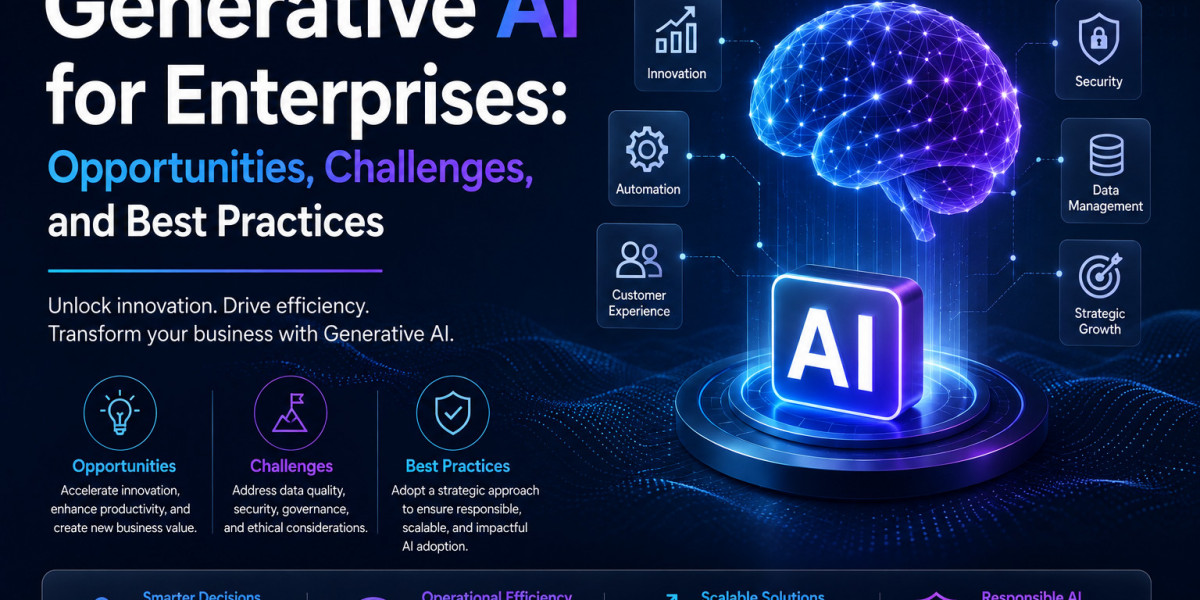

Every enterprise leadership team I've talked with over the past two years has landed in roughly the same place with generative AI. Excitement about what it could do, followed by a slower, more cautious conversation about what could go wrong if it's rolled out carelessly. That second conversation isn't hesitation for its own sake. It's the right instinct. Generative AI is powerful enough to genuinely change how a business operates, and exactly because of that, it deserves the same governance rigor as any other system that touches customer data, brand reputation, or regulatory exposure.
This piece is meant as a strategic overview for that whole conversation, not a pitch for a specific application. What generative AI can realistically do for an enterprise, where it tends to go wrong, and the practices that separate the deployments that hold up under scrutiny from the ones that quietly become a liability.
What Generative AI Means for the Enterprise
Generative AI, for an enterprise, means large language model-powered systems that produce text, summaries, code, or recommendations grounded in company data, deployed with the governance, security, and oversight standards that any enterprise-grade system requires. The technology itself is the same whether it's a consumer chatbot or an enterprise deployment. What changes is the standard it needs to meet.
That distinction gets lost sometimes. A consumer-facing generative AI tool can afford to be occasionally wrong in low-stakes ways. An enterprise deployment handling customer communications, internal policy questions, or regulated data cannot. This is why enterprise generative AI initiatives tend to move more slowly and deliberately than the public conversation around the technology might suggest, and why that slower pace is usually a sign of a mature approach rather than a lack of ambition.
Key Opportunities Generative AI Creates for Enterprises
Generative AI creates enterprise opportunities primarily in knowledge accessibility, content and communication scaling, and software development acceleration, each addressing a bottleneck that previously required significant manual effort or specialized expertise to overcome.
Knowledge accessibility improves when enterprise knowledge assistants, built using retrieval-augmented generation, give employees instant answers grounded in internal documentation instead of requiring them to search across disconnected systems or interrupt a colleague. This matters most in large organizations where institutional knowledge is scattered and turnover risks losing it entirely.
Content and communication scaling lets teams produce more marketing material, documentation, and customer communication without a proportional increase in headcount, with human review preserving quality and brand consistency.
Software development acceleration comes from generative AI assisting with code generation, test case creation, and documentation, speeding up parts of the development cycle that don't require deep architectural judgment while leaving that judgment with experienced engineers.
Customer experience improvements follow when support and service interactions are handled by assistants grounded in accurate product and policy information, reducing wait times for routine questions while escalating complex cases appropriately.
Key Challenges Enterprises Face with Generative AI
The main challenges enterprises face with generative AI are inaccurate or fabricated outputs, data privacy and security risk, unclear accountability when the system gets something wrong, and employee overreliance on AI-generated content without adequate review.
Inaccurate outputs, often called hallucinations, are a structural characteristic of how large language models work, not an occasional bug. A model will generate a confident, well-formatted answer even when it's wrong, which is particularly risky in contexts like legal, financial, or medical communication where an authoritative-sounding error can cause real harm.
Data privacy and security risk becomes significant when sensitive company or customer data flows through a generative AI system, particularly if that system relies on public APIs rather than private, dedicated infrastructure. Enterprises in regulated industries need clear answers about where data goes, how it's processed, and who can access it before any deployment.
Unclear accountability creates real organizational friction. When a generative AI system produces content that turns out to be wrong, biased, or inappropriate, someone needs to own that outcome. Enterprises that haven't defined this ownership structure in advance tend to find out the hard way, in the middle of an incident rather than during planning.
Employee overreliance happens quietly. Once a generative AI tool becomes part of daily workflow, the review step it was supposed to support can start to erode, particularly under deadline pressure. This is a change management problem as much as a technical one.
Best Practices for Deploying Generative AI in the Enterprise
Enterprises deploying generative AI successfully tend to follow a consistent set of practices: grounding outputs in verified company data, defining clear human review checkpoints, establishing accountability for AI-generated content, and starting with a scoped pilot before a broad rollout.
Ground outputs in verified company data. Retrieval-augmented generation, connecting the model to your actual documents through a vector database, significantly reduces the rate of fabricated or generic answers compared to relying on a model's general training knowledge alone.
Define clear human review checkpoints. Not every output needs the same level of scrutiny, but higher-stakes content, anything customer-facing, legally sensitive, or tied to a significant decision, should have a defined review step built into the workflow rather than left to individual discretion.
Establish accountability before launch. Decide who owns the outcome if a generative AI system produces something inaccurate or inappropriate, and make sure that ownership is clear to everyone involved before the system goes live, not after something goes wrong.
Start with a scoped pilot. Rolling out generative AI to one team or one well-defined use case first lets an enterprise catch issues, refine the review process, and build organizational trust before expanding further.
Communicate clear boundaries to users. Employees and customers interacting with a generative AI system should understand what it's reliable for and what it isn't, rather than assuming it's authoritative on everything.
Governance and Risk Management for Enterprise Generative AI
Generative AI governance in the enterprise centers on data security, output accuracy monitoring, and clear policies defining what the system is and isn't authorized to do autonomously, treated as an ongoing responsibility rather than a one-time setup step during deployment.
Data security policy needs to address where data is processed, whether through a public API or private, self-hosted infrastructure, and what data classification levels are appropriate for each. Enterprises in finance, healthcare, and other regulated industries increasingly lean toward private LLMs specifically to keep sensitive data off public infrastructure entirely.
Output accuracy monitoring means treating a generative AI system the way you'd treat any other production system: watching for degraded performance over time, not just checking accuracy once at launch. Company documents change, policies update, and a system's grounding data needs to stay current or its answers will drift out of date.
Clear authorization boundaries matter increasingly as generative AI capabilities extend toward agentic behavior, taking actions rather than just producing text. Defining explicitly what a system can do autonomously versus what requires human approval is a governance decision, not just a technical one, and it needs revisiting as capabilities expand.
Generative AI Opportunities vs Challenges: A Balanced View
Generative AI offers enterprises real gains in knowledge accessibility, content scale, and development speed, balanced against real risks in accuracy, data security, and accountability that require deliberate governance rather than being treated as minor implementation details.
| Category | Opportunity | Corresponding Challenge |
|---|---|---|
| Knowledge access | Faster access to institutional knowledge | Risk of confidently wrong answers if ungrounded |
| Content production | Higher output volume and speed | Quality and brand consistency risk without review |
| Development | Faster code and documentation generation | Requires experienced review, not blind trust |
| Customer experience | Faster, more available support | Escalation and accountability gaps if mishandled |
| Data use | Deeper use of internal knowledge | Data privacy and security exposure if ungoverned |
Neither column tells the full story alone. The enterprises getting real value from generative AI are the ones actively managing both sides of this table, not the ones focused only on the opportunity column.
How to Choose a Generative AI Partner for Enterprise Deployment
The right generative AI partner for an enterprise deployment has direct experience with production systems in regulated or high-stakes environments, a clear approach to grounding and accuracy monitoring, and a track record of building governance and accountability structures into deployments rather than treating them as an afterthought.
Checklist for evaluating a partner:
- Experience deploying generative AI in regulated or high-stakes enterprise environments
- A clear approach to data security, including private infrastructure options where needed
- A defined process for accuracy monitoring and grounding data upkeep
- Experience building human review checkpoints into generative AI workflows
- Clear guidance on governance and accountability structures
- Transparent terms on data ownership and model portability
- Direct, specific communication about realistic risk and limitations, not just capability
The Path Forward for Enterprise Generative AI
Generative AI in the enterprise is moving toward tighter integration with agentic systems, stronger governance requirements, and wider adoption of private, self-hosted models as more organizations weigh the opportunity against the accountability that comes with broader deployment.
As generative AI capabilities extend toward taking action rather than just producing content, the governance question becomes more urgent, not less. An enterprise comfortable with a generative AI system drafting a document has a different risk calculation than one considering a system that can send that document or take an action based on it autonomously. Getting the opportunity right in the enterprise increasingly means getting the governance right first, not treating it as something to figure out after the technology is already live.
Conclusion
Generative AI offers enterprises genuine opportunity in knowledge access, content scale, and development speed, but that opportunity only holds up when it's paired with real governance around accuracy, data security, and accountability. The enterprises seeing lasting value from generative AI aren't the ones that moved fastest. They're the ones that built grounding, review, and ownership into the deployment from the start, rather than treating those as problems to solve later.
If your enterprise is weighing where and how to deploy generative AI responsibly, it's worth a direct conversation about your specific risk profile and governance requirements before committing to a rollout.
Frequently Asked Questions
What are the biggest opportunities generative AI offers enterprises?
The biggest opportunities are faster access to internal knowledge, increased content and communication output without proportional headcount growth, and accelerated software development through code and documentation generation.
What are the main risks of using generative AI in an enterprise?
The main risks are inaccurate or fabricated outputs, data privacy and security exposure, unclear accountability when something goes wrong, and employee overreliance on AI-generated content without proper review.
How can enterprises reduce the risk of inaccurate generative AI outputs?
Grounding the model in verified company data through retrieval-augmented generation, combined with clear human review checkpoints for higher-stakes content, significantly reduces the risk of inaccurate or fabricated responses.
Is generative AI safe to use with sensitive enterprise data?
It can be, provided the enterprise has clear data governance policies in place, and for highly sensitive data, uses private or self-hosted infrastructure rather than public APIs.
Who is accountable when a generative AI system produces inaccurate content?
This should be defined before deployment, not after an incident. Enterprises need clear internal ownership for AI-generated content, particularly for anything customer-facing or legally sensitive.
Should enterprises start with a pilot before a full generative AI rollout?
Yes. A scoped pilot on one team or use case lets an enterprise refine its review process and build organizational trust before expanding to a broader deployment.
How is enterprise generative AI different from consumer generative AI tools?
Enterprise generative AI needs to meet governance, security, and accuracy standards appropriate for business-critical use, while consumer tools can generally tolerate a higher margin of error in lower-stakes contexts.
What does good generative AI governance look like in practice?
Good governance includes data security policy, ongoing accuracy monitoring, clear boundaries on what the system is authorized to do autonomously, and defined accountability for AI-generated outputs.