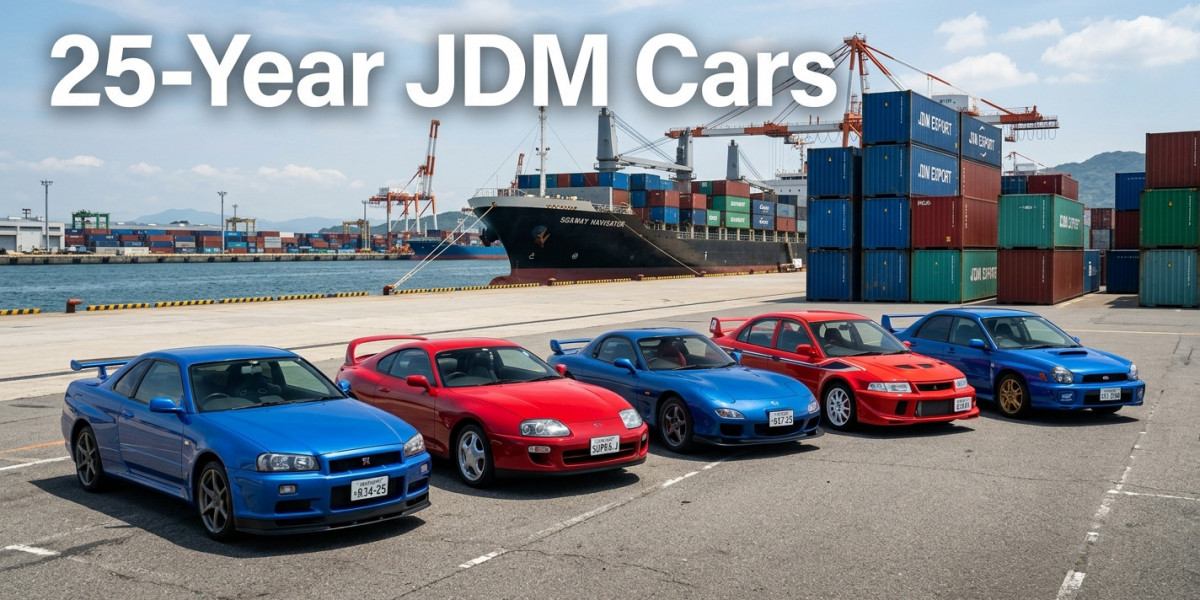

For enthusiasts, the 25-year import threshold represents more than a number on a calendar. It can transform the possibilities for acquiring Japanese performance cars that were previously difficult or impossible to import permanently into the United States. Once a qualifying vehicle reaches at least 25 years from its date of manufacture, NHTSA permits it to be imported without regard to compliance with applicable Federal Motor Vehicle Safety Standards. The crucial detail is that the 25-year period is calculated from the vehicle's manufacture date, not simply its model designation.
That makes the growing pool of 25-year JDM cars particularly interesting for American buyers. From lightweight coupes to turbocharged icons, several Japanese sports cars offer a compelling combination of performance, engineering character, and cultural significance.
What Does the 25-Year Rule Mean?
Under the U.S. importation framework, a motor vehicle that is at least 25 years old can generally enter the country without needing to meet the Federal Motor Vehicle Safety Standards that would apply to a newer nonconforming vehicle. NHTSA states that the age is determined from the date of manufacture. If the manufacturing date is not clearly documented on the vehicle, supporting records such as an invoice or registration documentation may be necessary.
This rule is one reason Japanese imports have become increasingly attractive to American enthusiasts. Cars that once required complicated eligibility considerations can become substantially more straightforward to import once they cross the relevant age threshold.
However, the 25-year rule should not be interpreted as a blanket exemption from every U.S. requirement. Importers should still verify applicable customs, emissions, documentation, state registration, and other requirements before purchasing a vehicle.
1. Nissan Skyline GT-R R34
The Nissan Skyline GT-R R34 remains one of the most recognizable Japanese performance cars of its generation. Its RB26DETT inline-six, sophisticated all-wheel-drive system, and unmistakable styling have made it a cornerstone of JDM culture.
As individual R34 examples reach the required age, demand is likely to remain closely tied to condition, originality, specification, and documented history. Buyers should pay particular attention to corrosion, previous modifications, engine condition, and auction documentation.
For enthusiasts researching JDM sports cars to import USA, the R34 represents the kind of Japanese performance machine that illustrates why the 25-year rule attracts so much attention.
2. Toyota Supra A80
The fourth-generation Toyota Supra, known as the A80, occupies another prominent position among Japanese performance cars.
Its twin-turbocharged 2JZ-GTE became famous for its substantial tuning potential, while the rear-wheel-drive chassis and robust mechanical architecture gave the Supra enduring appeal. Naturally aspirated and turbocharged versions can differ considerably in desirability and market value, so buyers should establish the exact factory specification before committing to an import.
A well-documented Japanese-market Supra can also provide a fascinating alternative to purchasing an already-established U.S.-market performance car.
3. Mazda RX-7 FD
The third-generation Mazda RX-7 is one of the most distinctive choices among Japanese imports.
Its compact dimensions, low weight, balanced chassis, and twin-turbocharged rotary engine created a sports car with an entirely different character from conventional piston-engine rivals. The rotary engine is also the reason prospective owners need to approach an RX-7 with particular diligence.
Compression testing, cooling-system condition, turbocharger health, oil consumption, maintenance records, and evidence of previous modifications deserve close examination. A neglected RX-7 can become an expensive project, while a properly maintained example can be an exceptionally engaging enthusiast car.
4. Honda NSX
The first-generation Honda NSX brought exotic-car philosophy into a comparatively compact and sophisticated Japanese package.
Its naturally aspirated V6, aluminum construction, mid-engine layout, and carefully developed chassis made it unusual when new and historically important today. Earlier examples are already beyond the 25-year threshold, making the NSX a particularly significant option for collectors interested in Japanese performance engineering.
Because values can vary dramatically according to mileage, transmission, maintenance history, and originality, documentation is especially important when evaluating an imported NSX.
5. Mitsubishi Lancer Evolution VI
The Mitsubishi Lancer Evolution VI offers a very different interpretation of Japanese performance.
Developed around rally-inspired engineering, the Evo VI combines turbocharged power with an advanced all-wheel-drive platform. Its compact proportions and competition-bred character have helped it maintain a strong following among enthusiasts.
When examining an imported example, attention should extend beyond the engine. Differential condition, drivetrain components, suspension, rust, accident history, and modifications can all influence the ownership experience.
6. Subaru Impreza WRX STI
The Subaru Impreza WRX STI is another compelling candidate for buyers exploring older Japanese performance vehicles.
Its turbocharged boxer engine and symmetrical all-wheel-drive configuration provide a distinctive driving experience, while its rally heritage gives the car considerable cultural significance. Different Japanese-market generations and specifications can vary substantially, so researching the exact chassis code and factory configuration is essential.
For buyers considering 25-year JDM cars, the WRX STI can offer a combination of everyday practicality and motorsport-inspired engineering that many traditional sports coupes cannot match.
7. Nissan Silvia S15
The Nissan Silvia S15 is particularly appealing to enthusiasts interested in rear-wheel-drive Japanese coupes.
Its relatively compact dimensions, SR20DET powerplant in higher-performance variants, and strong aftermarket support have made it a favorite within the drifting and tuning communities. Once an individual example satisfies the applicable age requirement, the S15 becomes an intriguing prospect for U.S. enthusiasts seeking something less conventional than a Supra or GT-R.
The condition of the chassis is critical. Modified drift cars can have experienced substantial mechanical stress, so a documented, structurally sound example deserves careful consideration.
8. Toyota MR2 Turbo
The second-generation Toyota MR2 Turbo offers another route into classic Japanese performance.
With a mid-engine layout, turbocharged four-cylinder engine, and relatively compact dimensions, the MR2 provides a driving experience that differs considerably from front-engine Japanese sports cars. Its combination of mechanical simplicity and unusual configuration makes it worth considering for enthusiasts who want something distinctive.
Rust, cooling systems, suspension components, and evidence of previous modifications should be inspected carefully before importation.
What to Check Before Importing a JDM Sports Car
Choosing a model is only the beginning. A Japanese auction listing can make an attractive car appear inexpensive, but the purchase price is only one part of the final calculation.
Before buying, verify:
- Exact manufacture date and eligibility under the 25-year rule
- Auction sheet and vehicle history
- Chassis and engine condition
- Rust and previous accident repairs
- Originality and quality of modifications
- Export and ownership documentation
- Shipping and port costs
- Customs duties and applicable fees
- State-specific title and registration requirements
- Availability and cost of replacement parts
The manufacture date deserves particular attention because NHTSA specifically bases the 25-year exemption on the vehicle's date of manufacture.
Why Japanese Imports Are Becoming More Interesting
The appeal of Japanese imports extends beyond nostalgia. Many of these vehicles represent engineering philosophies that are difficult to replicate in today's automotive market: compact dimensions, naturally aspirated engines, manual transmissions, lightweight construction, mechanical differentials, and distinctive turbocharged powertrains.
At the same time, scarcity matters. As more enthusiasts discover older Japanese performance cars, well-preserved examples with credible documentation can become increasingly difficult to locate.
That makes condition and provenance just as important as the badge on the hood.
Final Thoughts
The best JDM sports cars to import USA are not necessarily the most famous or expensive models. The right choice depends on the buyer's priorities, whether that means collecting an iconic GT-R, enjoying the balance of an RX-7, experiencing the precision of an NSX, or building a distinctive Silvia or Evo.
The 25-year rule simply opens the door. The real work begins with identifying an eligible vehicle, verifying its history, assessing its mechanical condition, calculating the complete landed cost, and confirming the requirements that apply in the state where it will be registered.
For enthusiasts searching for JDM sports cars to import, that combination of careful research and patience can turn the arrival of a newly eligible Japanese performance car into a genuinely rewarding ownership opportunity.