
Headless commerce gives businesses more control over storefront design, customer experiences, and front-end technology. But separating the storefront from BigCommerce’s commerce engine also introduces additional infrastructure, development work, and ongoing maintenance.
The architecture can be valuable when a business has specific requirements that a traditional storefront cannot meet. It can also create unnecessary complexity when the team adopts headless simply because it sounds more modern.
Before committing to a headless project, evaluate the business need, technical readiness, and long-term operating costs. These four warning signs can help identify when the approach may create more problems than it solves.
1. Your Business Goals Do Not Require a Separate Front End
Headless architecture separates the customer-facing storefront from the commerce platform that manages products, carts, checkout, and orders. This separation allows teams to build custom experiences, but it also means they must develop and maintain more of the storefront themselves.
If your primary goals are improving page design, updating product pages, or making small changes to the shopping journey, a traditional BigCommerce storefront may already provide the functionality you need.
What to look for
The current storefront is not the main constraint: Slow performance, poor conversion rates, or navigation issues may be caused by product data, third-party scripts, checkout friction, or weak merchandising—not the storefront architecture.
Your requirements fit existing capabilities: If the store mainly needs standard product pages, category navigation, promotions, and checkout, a separate front end may add complexity without delivering a meaningful advantage.
The business case is based on trends: “We need headless because other brands are using it” is not a measurable objective. The project should be tied to outcomes such as faster experimentation, better performance, or a specific customer experience.
What to do before committing
First, identify the problems the project needs to solve and record baseline metrics such as conversion rate, page speed, mobile engagement, and development turnaround time. Then compare a headless setup with improvements to the existing storefront.
The right BigCommerce development approach should be based on your business needs, not on the assumption that headless is always better. If your current storefront can meet those needs with less cost and maintenance, a headless build may not be worth it.
2. Your Team Is Not Prepared to Own the Added Technical Complexity
A headless storefront introduces a separate front-end application that must communicate with BigCommerce through APIs. The team may also need to manage hosting, deployments, caching, monitoring, and the connection between the storefront and commerce services.
That work does not disappear after launch. It becomes part of the store’s ongoing operating model.
What to look for
No clear technical owner: If no one is responsible for the front-end application, API integrations, deployment process, and production issues, maintenance responsibilities may become unclear.
Limited experience with the required framework: Headless projects often rely on modern JavaScript frameworks and API-driven development. A team without relevant experience may face longer development cycles and more defects.
Unrealistic expectations about maintenance: A custom storefront still needs security updates, dependency management, performance monitoring, and compatibility testing.
A vendor-only knowledge base: If the implementation team retains all technical knowledge, even routine changes may require external support.
What to do before committing
Assess the team’s ability to build and maintain the front end after launch. Confirm who will handle incidents, updates, performance issues, and future feature requests. Include training, documentation, and support in the project plan.
Also define the integration boundaries. Identify which functions will remain within BigCommerce and which will be handled by the custom storefront. A clear division of responsibilities reduces the risk of duplicated logic and inconsistent customer experiences.
3. The Project Budget Covers the Build but Not the Full Cost of Ownership
Headless projects are often evaluated by their initial development estimate. That can produce an incomplete picture because the storefront, infrastructure, integrations, testing, and ongoing maintenance may all require separate investment.
The cost is not limited to creating the visual interface. Teams must also ensure that the storefront reliably handles product data, customer sessions, cart updates, checkout, and other commerce workflows.
What to look for
The estimate excludes infrastructure: Hosting, content delivery, monitoring, and other services may add recurring costs.
Integrations are treated as minor tasks: Search, personalization, analytics, reviews, promotions, and customer account systems may require additional API work.
Testing is underfunded: A custom front end needs testing across devices, browsers, user journeys, and integration scenarios.
The business has not planned for future changes: New features, framework upgrades, API changes, and additional storefront requirements can increase the total cost over time.
What to do before committing
Build a total cost of ownership estimate that covers development, hosting, third-party tools, testing, support, and future enhancements. Compare that estimate with the cost of improving the current storefront.
The comparison should also account for the business impact of the proposed improvements. For example, if headless is expected to improve mobile conversion or reduce release time, define how those outcomes will be measured and when the investment is expected to pay off.
A lower initial estimate is not necessarily a lower-cost solution. The more useful comparison is the cost of operating each architecture over the period the business expects to use it.
4. Your Storefront Depends on Integrations That Have Not Been Validated
A headless storefront can create a polished customer experience, but that experience depends on reliable data exchange between the front end and the commerce platform. If key integrations are incomplete or poorly understood, the architecture may introduce friction instead of removing it.
This risk is especially important for stores with complex pricing, customer-specific catalogs, multiple inventory sources, or customized checkout requirements.
What to look for
Critical workflows rely on assumptions: The project team has not verified how customer groups, promotions, product options, inventory, or checkout requirements will work through the selected APIs.
Data updates are not clearly defined: The team has not decided how quickly product, price, and inventory changes must appear on the storefront.
Error handling is missing: There is no plan for API failures, delayed responses, expired sessions, or unavailable third-party services.
The checkout experience is not fully mapped: The team has not tested the complete journey from product selection through payment and order confirmation.
What to do before committing
Create an integration inventory before development begins. For each system, document the data exchanged, the API or connection method, the update frequency, and the owner responsible for resolving failures.
Then validate the most important customer journeys with a small technical proof of concept. Test product discovery, variant selection, cart updates, customer login, promotions, checkout, and order confirmation. Include failure scenarios—not only the ideal path.
If critical workflows cannot be supported reliably, resolve those gaps before expanding the project. A visually impressive storefront cannot compensate for inaccurate inventory, broken carts, or checkout errors.
How to Decide Whether Headless Is the Right Move
Headless BigCommerce can be a strong fit when a business needs a distinctive customer experience, has complex front-end requirements, or wants to support multiple customer-facing channels. It is less compelling when the goals can be achieved through standard storefront capabilities or when the organization is not ready to maintain a custom application.
Before approving the project, answer these questions:
What specific business problem will headless solve?
Which requirements cannot be met efficiently with the existing storefront?
Who will maintain the front end and integrations after launch?
What is the full cost of building and operating the solution?
Have the critical commerce workflows been tested through the proposed architecture?
Which metrics will determine whether the investment was successful?
If these questions do not have clear answers, the project is not ready for commitment.
Conclusion
Headless is an architectural choice, not a guaranteed upgrade. It can provide flexibility and control, but it also creates additional responsibilities for development, integration, testing, and maintenance.
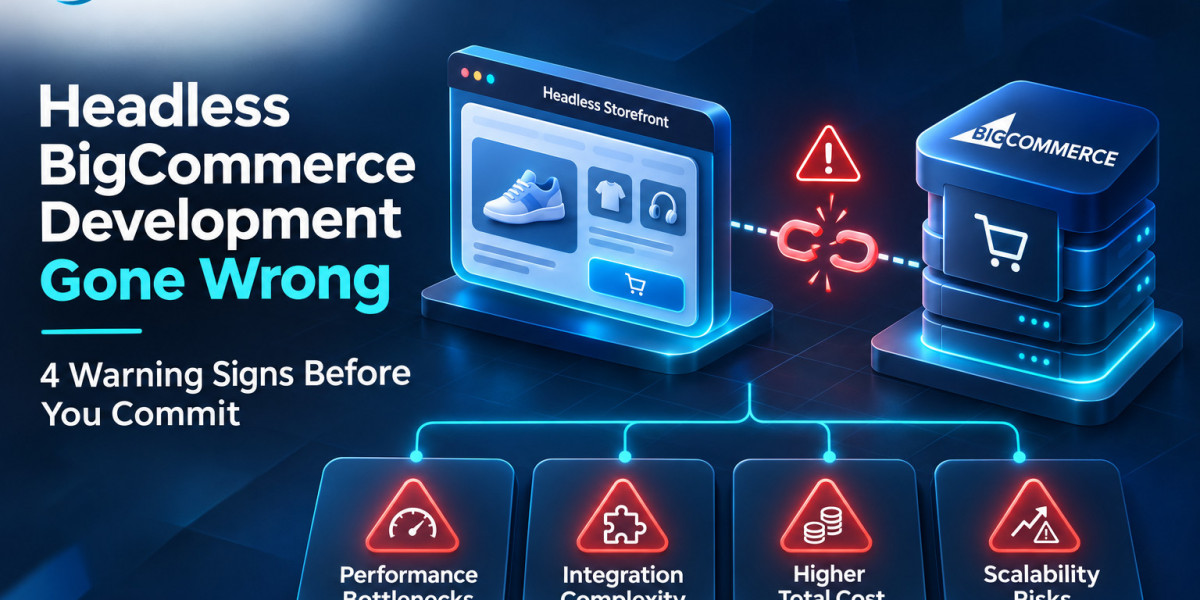
The four warning signs—unclear business goals, limited technical readiness, an incomplete cost estimate, and unvalidated integrations—should be addressed before work begins. A careful assessment can help businesses avoid investing in an architecture that adds complexity without delivering measurable value.
EmizenTech supports businesses with BigCommerce development, including storefront planning, custom functionality, and integrations. The right starting point is a clear assessment of business requirements and technical constraints, followed by an architecture that supports both the customer experience and long-term operations.